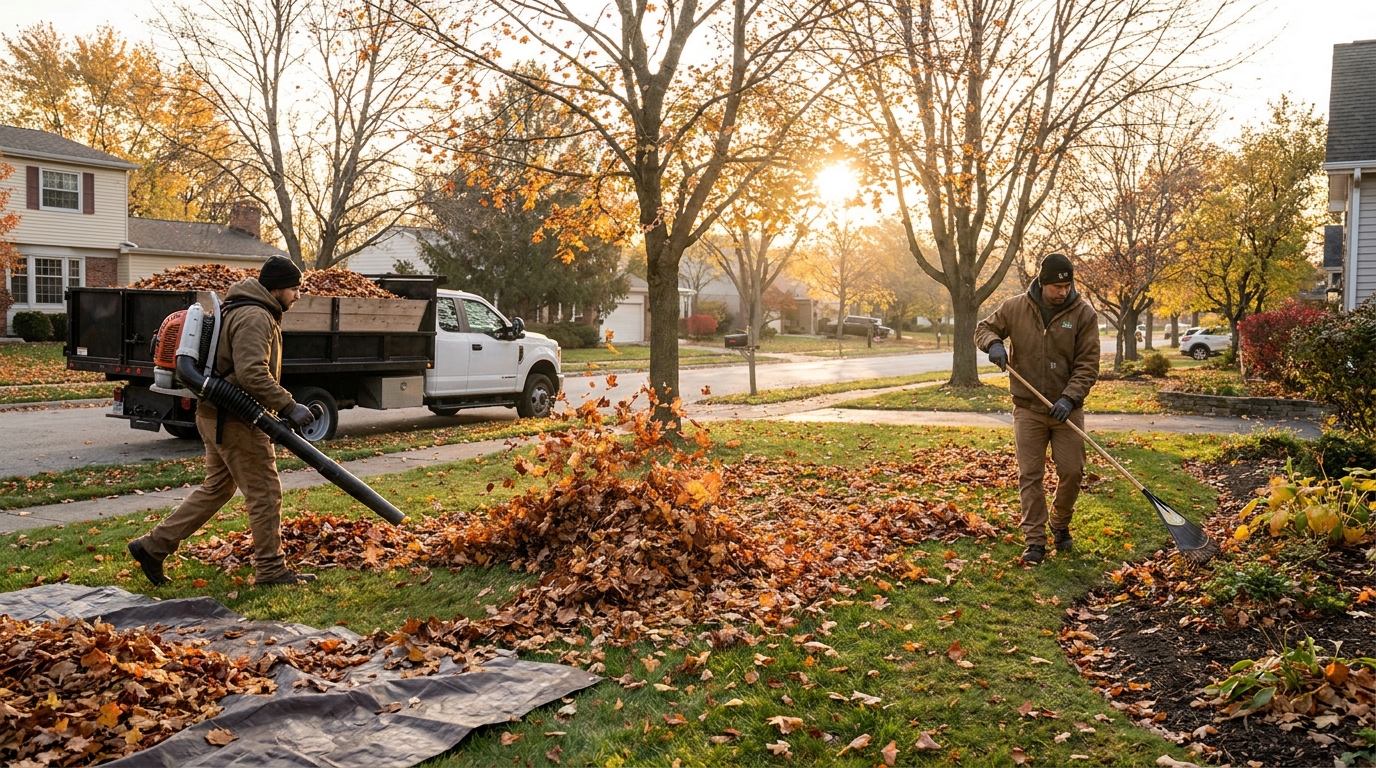
Every autumn a customer holds up their phone and tells you leaf removal costs forty dollars an hour. You are standing there with two people, a blower, a tarp, and a trailer that has to be emptied before dark, and the arithmetic does not work. They are not making the number up. They read it on a page that was updated four days ago. The problem is that the page counts a different kind of hour than the one you are selling.
This is a pricing guide for the person doing the work, not the person paying for it. It uses one stated book all the way through so the numbers stay checkable: sixty maintenance clients at $52 a visit over a 32-week season, of which forty properties have enough tree cover to want a fall cleanup, worked by a two-person crew costing $52.80 an hour fully loaded. Fuel is EIA's July 2026 Short-Term Energy Outlook on-highway diesel forecast of $4.61 a gallon, read from the STEO table today. Your market is not this market. The structure of the math is the part that travels.
The two numbers on the same search results page
On 2026-08-08 the results for "how much to charge for leaf removal" put homeowner cost guides and operator pricing guides on the same screen. They do not agree, and the disagreement is not about price. It is about what an hour means.
LawnStarter's leaf removal cost guide, updated 2026-08-04, publishes hourly figures by method: leaf raking $25 to $50 an hour, leaf blowing $15 to $45 an hour, leaf vacuum $37 to $60 an hour. ECHO's business-resources page for contractors publishes labor "commonly ranging from $40 to $80 per person-hour." Those are the same word and two different units.
| Source (read 2026-08-08) | Published rate | Per hour of a 2-person crew on site | A 90-minute visit |
|---|---|---|---|
| LawnStarter, leaf blowing | $15 - $45 / hour | $15 - $45 | $23 - $68 |
| LawnStarter, leaf raking | $25 - $50 / hour | $25 - $50 | $38 - $75 |
| LawnStarter, leaf vacuum | $37 - $60 / hour | $37 - $60 | $56 - $90 |
| ECHO, contractor guidance | $40 - $80 / person-hour | $80 - $160 | $120 - $240 |
The sharpest version of this is internal to one page rather than a comparison across two. LawnStarter's own guide also states a typical total of about $170 a visit and a range of $160 to $290 for a standard quarter-acre yard. Its own highest published hourly rate is $60. To reach $170 at $60 an hour you need a 2.8-hour visit; at the blowing midpoint of $30 an hour you need 5.7 hours. Meanwhile an operator quoting off ECHO's person-hour rates prices that same $170 job at roughly 1.4 crew-hours. The totals reconcile. The hours do not, by a factor of two to four.
Nobody here is lying. One page is describing elapsed hours of service from the customer's side of the driveway and the other is describing labor hours billed. But you are the one who has to close the gap out loud, in October, on someone's front lawn. The useful thing to know is this: when a customer pushes back on a leaf quote, the number they are holding is almost always an hours number, not a price number. Answering it with a price argument loses. Answering it with "that rate is per person, and there are two of us, for ninety minutes" ends it in one sentence.
A note on method, because it limits what I can claim. I read the operator-facing pages on this results page directly rather than quoting search snippets. LawnStarter returned the full article and every figure above comes from it. GreenPal's leaf pricing article returned HTTP 503 to our fetch, so it is excluded from this comparison rather than characterised from a snippet. Two of the ten results were a 2019 Reddit thread and a 2021 LawnSite thread, which tells you something about how current the operator-facing advice on this term is.

The three ways to price it, and what each one does to you
There are only three structures. Hourly, flat per visit, or a seasonal package of two to three passes. Most advice tells you to pick the one you are comfortable with. That is backwards. The right structure is a function of how many trees are on the property, and getting it wrong costs more than getting the rate wrong.
Hourly is the one to be most careful with, because it punishes you for being good at this. Buy a $4,000 leaf loader and a $600 backpack blower, cut the job from three hours to ninety minutes, and hourly billing hands the entire saving to the customer. You paid for the equipment and they got the discount. Hourly also turns every rain delay into an argument, because wet leaves take longer and the customer can see the clock.
Flat per visit is the default for a reason: it prices the outcome, keeps the efficiency gain, and is the only structure a customer can compare against a competitor without a calculator. Its failure mode is the heavy-tree property, where one visit at the end of the season means deep, wet, matted leaves and a job that runs 60% longer than the one you quoted.
Two or three passes solves that, and the arithmetic is better than most operators assume. Here is the same forty-property book priced both ways.
| Line | One heavy cleanup | Three light passes |
|---|---|---|
| Price to the customer | $250 | 3 x $110 = $330 |
| Crew-hours on site | 2.5 | 3 x 0.8 = 2.4 |
| Drive time charged to the job | 0.2 | 3 x 0.2 = 0.6 |
| Total crew-hours | 2.7 | 3.0 |
| Crew cost at $52.80/hr | $142.56 | $158.40 |
| Gross margin | $107.44 (43%) | $171.60 (52%) |
| Across 40 properties | $10,000 revenue / $4,298 margin | $13,200 revenue / $6,864 margin |
Three passes bills 32% more and costs 11% more. The extra drive time is real and it is in the table, and it still loses to the compounding effect of never letting the leaf layer get deep. Across forty properties that is $2,566 of additional gross margin from a billing-structure decision, not a rate increase - about 2.6% of the mowing season's revenue, earned by changing a sentence in the quote.
Now the inversion, because this only works under a condition most articles skip. Three passes requires a customer who accepts three appearances and three invoices. On a property with two ornamental trees, the third pass is a visit you cannot justify, and the operator who sells three passes to a two-tree property is the one whose reviews say they came out and did nothing. Count the trees before you pick the structure. Heavy canopy gets passes. Light canopy gets one flat visit. A mixed book gets both, quoted separately, which is exactly the kind of thing that is easy on paper and miserable in a spreadsheet.
The disposal line, and the part of it nobody prices
ECHO's page does better than most here. It publishes hauling to a disposal facility at "$75-100 per trip" and bagging for municipal pickup at "$1-2 each," and it notes that blowing leaves into a wooded area on the property costs nothing to dispose of. Those are real numbers and they are on the SERP.
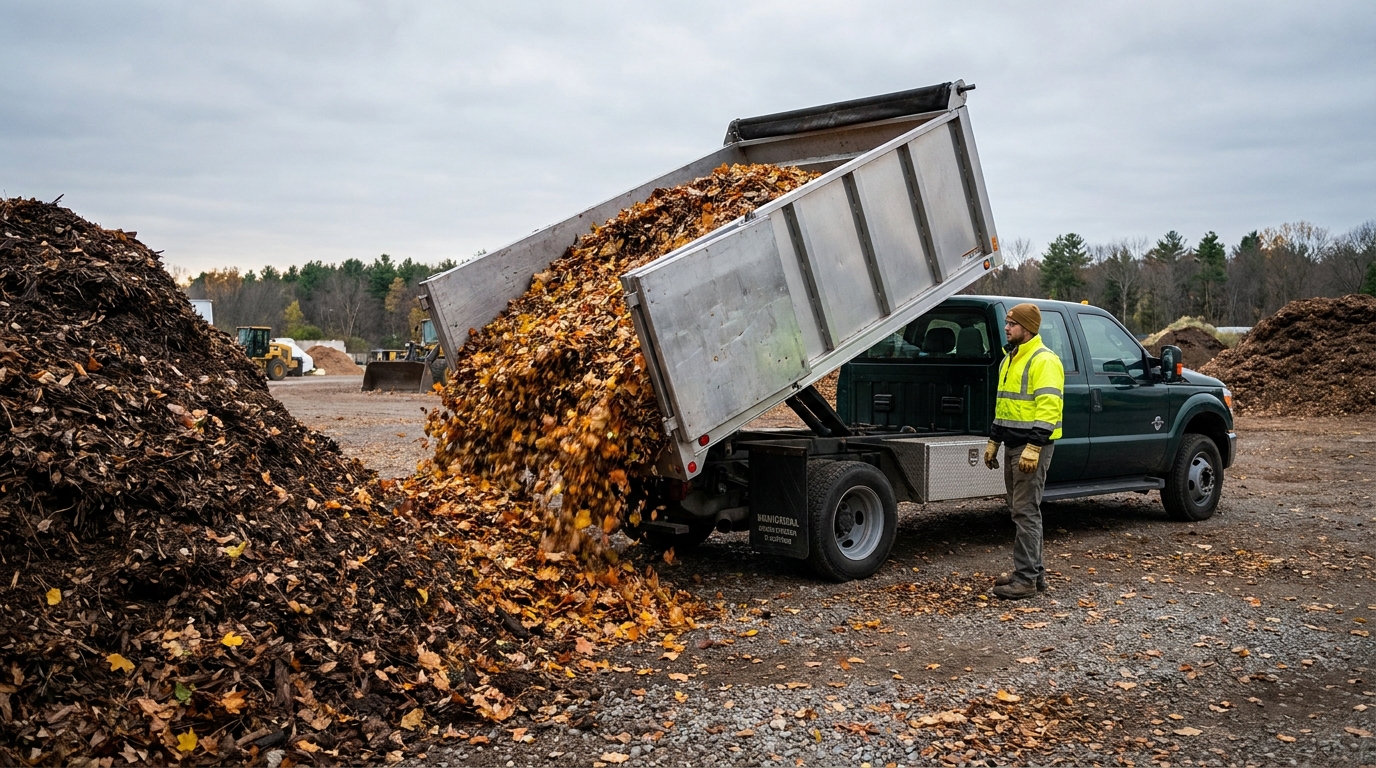
What is not on the SERP, on any of the ten results, is the clock. A dump run is not a fee. It is a fee plus most of an hour.
| Line item for one dump run | Cost | Published on this SERP? |
|---|---|---|
| Tip fee at the facility | $75 - $100 | Yes |
| 18-mile round trip, loaded, through town | 39 min | No |
| Queue, tarp, tip, re-tarp | 15 min | No |
| 54 minutes of a 2-person crew at $52.80/hr | $47.52 | No |
| Fuel, 18 miles at 11 mpg, $4.61/gal | $7.55 | No |
| True cost of one dump run | $130 - $155 | No |
The tip fee is a third to a half of what the run actually costs you. And the bigger number is not even the money: 54 minutes is 11% of an 8.4-hour working day, spent driving to a place where nobody is paying you. Two runs in a day and you have given away 22% of your capacity in the busiest six weeks of your year.
Three consequences follow, and none of them are "charge more for disposal." First, a bigger trailer is not a vanity purchase, it is a capacity purchase - the box that turns two runs into one buys back an hour a day. Second, on-site disposal is worth real money where the property allows it, and it is worth asking about at the quote rather than discovering at 4pm. Third, if your yard-waste facility is nine miles away and a competitor's is three, they can underbid you on identical work and still make more, and no amount of pricing advice fixes that.
What leaf season does to your route
This is the section every page on this results page is missing, and it is the one that decides whether your fall is profitable or just exhausting. Leaf cleanup does not slot into a mowing day. It replaces it.
| A mowing day | A cleanup day | |
|---|---|---|
| Time on site per stop | 30 min | 90 min |
| Drive between stops | 12 min | 12 min |
| Minutes consumed per stop | 42 | 102 |
| Dump runs | 0 | 1 (54 min) |
| Stops in a 504-minute day | 12 | 4 |
| Revenue per stop | $52 | $250 |
| Revenue per day | $624 | $1,000 |
| Clients served that day | 12 | 4 |
Read the last two rows together, because they say opposite things. A cleanup day grosses 60% more than a mowing day. It also serves a third as many clients. Both are true and the second one is what breaks the calendar.
Forty cleanups at four a day is ten full working days of capacity. Leaves in most of the northern half of the country come down over about six weeks, and those six weeks still contain roughly four weeks of mowing that has not stopped yet. Ten days of cleanup plus twenty days of mowing does not fit in thirty working days once you subtract rain, breakdowns, and the fact that leaves do not fall on a schedule that respects your route order.
That is the real reason fall feels like a crisis every year, and it is a scheduling problem wearing a pricing problem's clothes. It also explains why the seasonal-pass model keeps winning for heavy-canopy books: three 30-minute passes spread across the window fit into days you are already driving, while one 150-minute visit demands a day you do not have.
Here is the inversion, published because it cuts against the complaint. Cleanup days pay better per day than mowing days. If your fall feels like the worst part of the year, the problem is probably not the price of leaf work. It is that you sold ten days of it into a calendar with four days free, and then absorbed the difference in evenings. Fixing the calendar is worth more than fixing the rate.
The minimum charge is a break-even, not a floor
LawnStarter reports that "most professionals charge a minimum fee of $80 for a leaf removal service, regardless of how many hours they spend on the job." That figure is repeated widely enough to function as an industry standard. Run it against the book.
| Line | Value |
|---|---|
| Drive attributable to the stop | 12 min |
| Setup and teardown (unload, tarps, reload) | 8 min |
| Fixed crew time before any leaf moves | 20 min = $17.60 |
| Fuel, 4 miles at 11 mpg | $1.68 |
| Fixed cost per stop | $19.28 |
| 45 minutes of two-person work | 1.5 crew-hours = $79.20 |
| Total cost of a "small" cleanup | $98.48 |
| Price required for a 45% gross margin | $179 |
| Widely quoted industry minimum | $80 |
An $80 minimum does not cover a 45-minute two-person stop. It is $18 below cost before anyone has been paid a margin. The number is not wrong in the abstract - it is wrong for the job most people apply it to.
Where it does work: a single person, thirty minutes, on a property already on today's route. That is 0.5 person-hours at $26.40 plus $19.28 of fixed cost, so $32.48 of cost against an $80 price, a 59% margin and a perfectly good minimum. The distinction that matters is not the dollar figure. It is how many people you are sending and whether the truck was already going to be on that street. Set two minimums, one for on-route stops and one for anything requiring a dedicated trip, and the number stops being an argument.
When the money lands, and the flat-monthly trap
Forty cleanups is $10,000 to $13,200 depending on structure - roughly 3.2 to 4.2 weeks of mowing revenue, earned in a six-week window that is already full, and it is the last significant money before four dead months. For a book like this one it is about 9% to 12% of the year.
| Mowing season | Fall cleanup block | |
|---|---|---|
| Weeks | 32 | ~6 (overlapping) |
| Revenue | $99,840 | $10,000 - $13,200 |
| Share of the year | 88% - 91% | 9% - 12% |
| Months of revenue after it | Zero, until spring | |
Which brings up the trap. If you bill flat monthly, there is a good chance the fall cleanup is already inside the annual number. You spread the season across twelve payments in the spring, the customer has been paying steadily since March, and then in November you do the single hardest week of the year for revenue you recognised in July. The customer is not cheating you. The contract is.
Flat monthly is a genuinely good structure and we have argued for it before, because it moves money into the dead months and smooths the cash flow that kills small operators in February. But it has to be built with the cleanup priced in explicitly, as a named line with a named number of passes, rather than absorbed under "seasonal maintenance." The clause that does this is worth more than the rate it contains - a point we worked through in detail in the lawn care contract template breakdown, where the billing-model clause alone swung 9.4% of the season.
If you are about to send the fall quote to a book of existing clients and the cleanup was previously bundled, that is a price conversation, not a quote. The mechanics of running it without losing accounts are the same ones in the price increase letter guide, and the margin arithmetic behind deciding how far to push sits in the profit margin walkthrough.
A worked quote you can copy
Quarter-acre property, mature canopy, four large deciduous trees, no on-site disposal, on an existing mowing route.
- Structure: three passes, because four mature trees will not clear in one visit without going deep and wet.
- Per pass: 0.8 crew-hours on site, 0.2 drive = 1.0 crew-hour at $52.80 = $52.80 cost.
- Disposal share: the property fills roughly a third of a trailer per pass; a $130 to $155 run split three ways is $43 to $52.
- Cost per pass: about $96 to $105.
- Price per pass at 45% margin: $175 to $190. Quote $180.
- Season total: $540, presented as three passes at $180, not as one number.
Present it as three passes and the customer compares $180 against their neighbour's single $250 cleanup and thinks you are cheap. Present it as $540 and they think you are expensive for the same work. Same job, same margin, different sentence. That is not a trick - it is an accurate description of a service that is genuinely delivered three times.
What software does and does not do here
Being blunt about our own product, because a pricing guide that ends in a sales pitch is not a pricing guide. Landscapey is a CRM for landscapers. It does not calculate leaf pricing. There is no leaf-volume estimator, no canopy analysis from an address, no per-service price book, and nothing in it will tell you what to charge in your market.
| What it does for fall work | What it does not do |
|---|---|
| Holds one-off cleanup jobs alongside the recurring mowing schedule for the same client | No leaf or debris volume estimating of any kind |
| Sequences a day's stops so a four-stop cleanup day is planned rather than discovered | No per-service price book or rate library |
| Bills per visit or flat monthly per client, so a three-pass package invoices as three visits | No time tracking against a job, so the crew-hours above are your estimate, not a measurement |
| Moves a rained-out day's visits without touching the recurring schedule | No multi-user crew accounts today - it is a single-operator login |
| One flat plan, no per-seat fee, no setup fee | No equipment or material costing, no per-visit photos, no e-signature |
The one claim worth checking on us: payments run through Stripe Connect as direct charges with no platform fee on top of Stripe's own rate, so you can do the arithmetic in advance rather than after settlement. Everything else in that left column is scheduling and billing plumbing, which is useful in the six weeks when your calendar is the binding constraint, and irrelevant to what you should charge. Pricing is here if the plumbing is the part you need.
Limits of everything above
One book, stated once: 60 clients, 40 with tree cover, $52 a visit, 32 weeks, a two-person crew at $52.80 an hour loaded. Every figure moves with tree count, which varies far more between properties than yard size does - a quarter-acre with six oaks is a different job from a quarter-acre with a hedge. The $52.80 crew cost is a stated loaded rate, not a survey. The $4.61 diesel figure is EIA's 2026 annual forecast from the July 2026 STEO, not a price at your pump today. The competitor figures are what those pages published on 2026-08-08 and pricing pages change; re-read them before you quote off them, including this one.
Frequently asked questions
How much should I charge for leaf removal?
For a standard quarter-acre property with real leaf load, the market clears somewhere around $160 to $290 a visit, with $170 typical. But the number you should charge is your cost plus your margin, and the cost is roughly $19 fixed per stop plus $52.80 per crew-hour plus a third to a half of a $130-to-$155 dump run. Work it that way and you will land inside the market band on most properties and correctly above it on the heavy ones.
Should I charge hourly or a flat rate for leaf cleanup?
Flat, in almost every case. Hourly hands the benefit of your equipment and your speed to the customer, and it turns every wet-leaf day into a negotiation. Hourly is defensible only for genuinely unpredictable one-off work - a property you have never seen, after a storm, with no way to scope it in advance.
What is a fair minimum charge for a fall cleanup?
Two minimums, not one. For a stop already on today's route with one person for half an hour, $80 works and carries about a 59% margin. For anything needing a two-person crew or a dedicated trip, $80 is below cost - a 45-minute two-person stop costs about $98 all in, and needs roughly $179 to carry a 45% margin.
How do I price disposal?
Price the run, not the fee. A tip fee of $75 to $100 is only part of it; the round trip and the queue cost you about 54 minutes of crew time and a few dollars of diesel, which puts the true cost of a run at $130 to $155. Divide that across the properties that filled the trailer and put it in the quote rather than eating it.
How many leaf cleanups can a two-person crew do in a day?
About four, on a normal route with one dump run. Ninety minutes on site plus twelve minutes of drive is 102 minutes a stop, and a 54-minute disposal run takes the rest. If you are planning six, you are planning to work past dark.
Should fall cleanup be included in a flat monthly contract?
Only if it is priced in explicitly, with a named number of passes. Bundled under "seasonal maintenance" it means doing the hardest work of the year for money you already collected in the summer. Name the passes, name the price, and let the monthly figure carry it.
If you take one thing from this: the fall is not expensive because leaf work is cheap to sell. It is expensive because four stops a day is a third of a mowing day's client count, and almost nobody prices that. Landscapey is free to try if the four-stop day is the part you need to plan rather than survive.