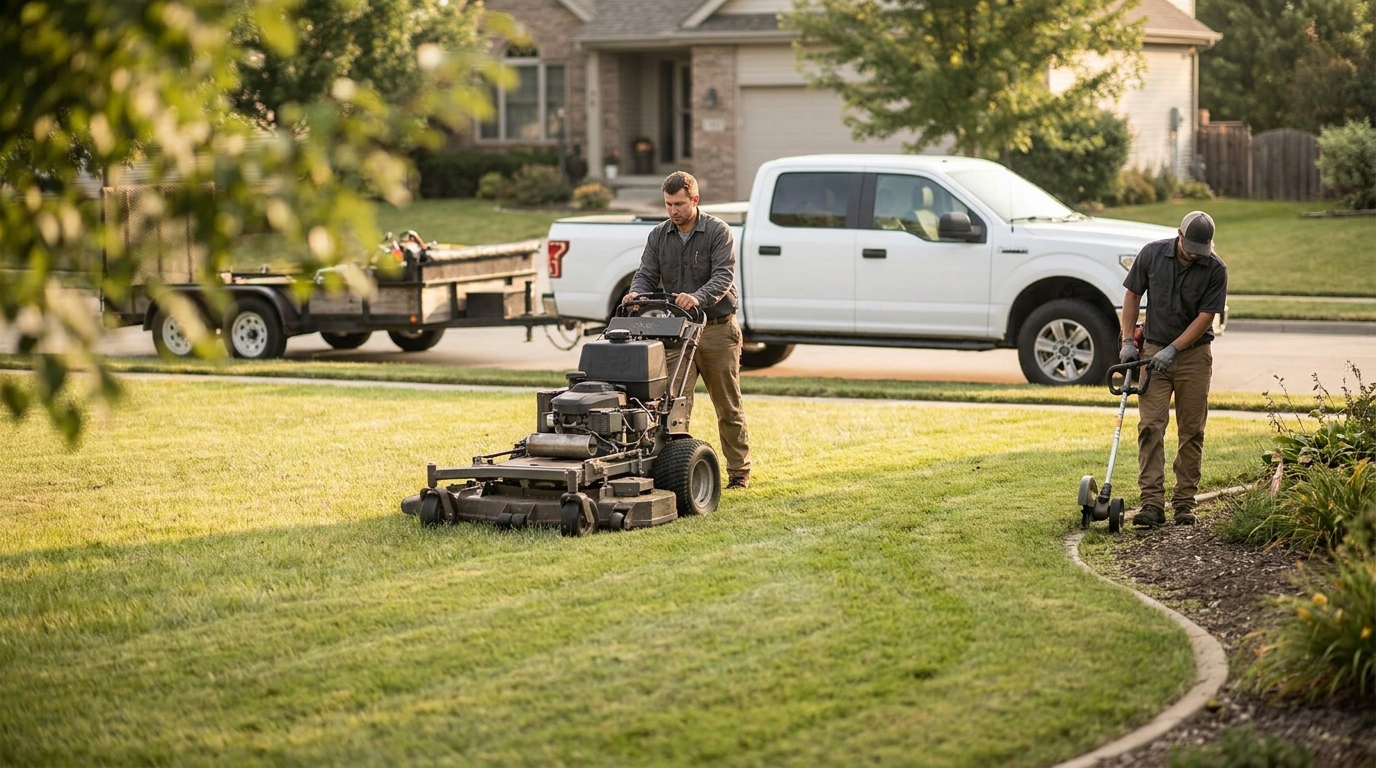
Every page that ranks for "lawn care business insurance" is selling you a policy, and almost all of them lead with the same number: general liability, somewhere between $34 and $51 a month. It is a real number. It is also about 11% of what you are actually going to pay.
This is a breakdown of the whole bill, not the advertised part of it: what each policy costs according to a carrier that publishes the median of what its own landscaping customers actually bought, what those numbers do to a 60-client maintenance book, why the same coverage limit is quoted at four different prices by four carriers on the same page, and the two ways a workers' comp audit turns a paperwork problem into a four-figure bill in January.
Not insurance advice, and not a quote. Every figure here is something a named source published on a date, and premiums move with your state, payroll, revenue, vehicles and claims history. Treat this as the arithmetic to bring to a broker, not a substitute for one.
What the whole stack costs, not just the part in the ad
Insureon publishes median premiums for landscaping businesses and is unusually clear about where the figures come from: "Our figures are sourced from the median cost of policies purchased by Insureon landscaping customers." That is a real methodology and also a real limit, which we will come back to. Their page was last updated 2026-02-24.
| Policy | Median per month | Median per year |
|---|---|---|
| General liability | $51 | $610 |
| Workers' compensation | $169 | $2,029 |
| Commercial auto | $204 | $2,452 |
| Tools and equipment | $38 | $450 |
| Business owner's policy (BOP) | $94 | $1,130 |
| Commercial umbrella | $88 | $1,060 |
| License and permit bond | $9 | $112 |
A one-truck operation with one employee needs four of those: general liability, workers' comp, commercial auto, and tools and equipment. At the medians that is $5,541 a year, or $461.75 a month.
General liability is $610 of $5,541 - 11.0%. The number every carrier page in this search result leads with is one ninth of the bill, because each of those pages is selling one policy at a time and general liability is the cheapest thing they sell. Nobody is lying. But an operator who budgets off the advertised figure has budgeted for eleven cents on the dollar.
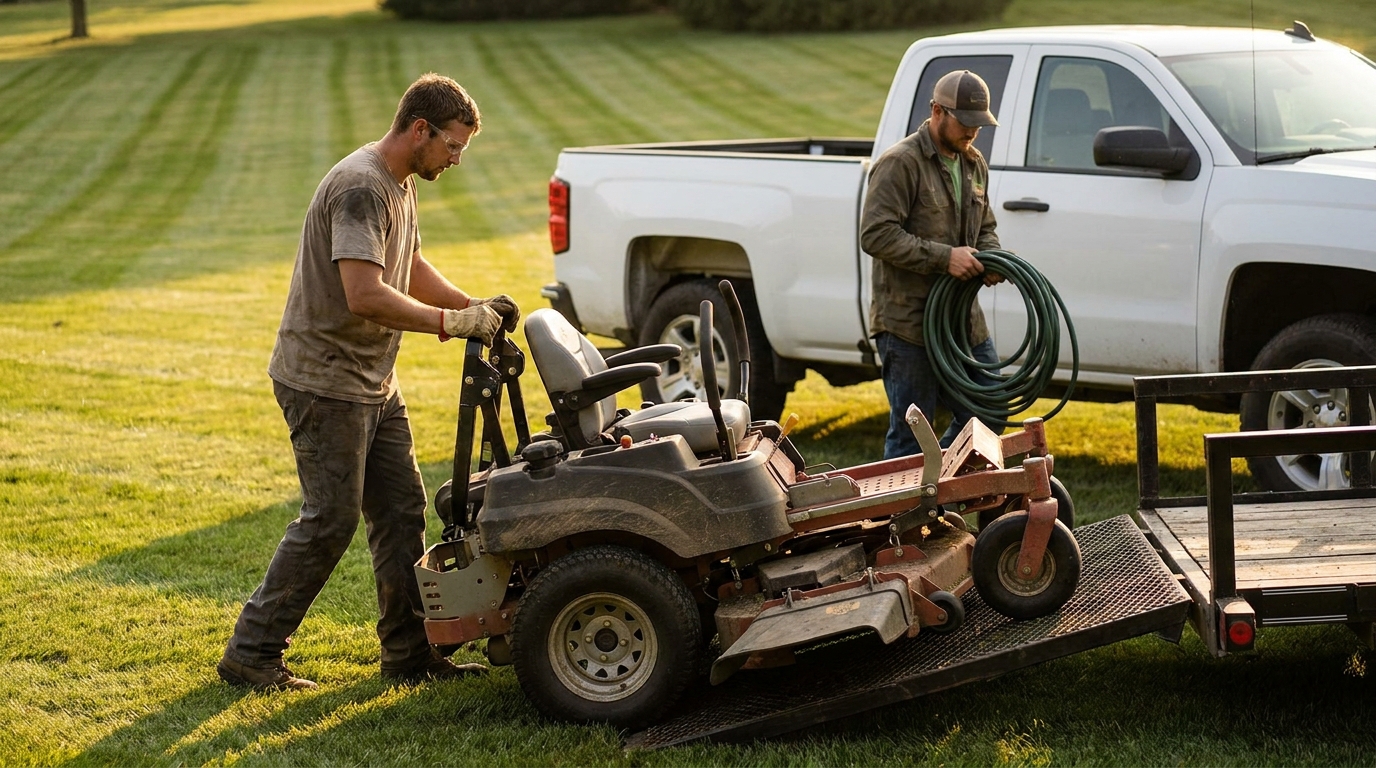
What $5,541 does to a real book
Same standing book we price everything against: 60 recurring clients at $52 a visit, a 32-week season. That is 1,920 visits and $99,840 of season revenue.
| Measure | Solo, no employees | One truck, one employee |
|---|---|---|
| Policies carried | GL + auto + tools | GL + auto + tools + workers' comp |
| Annual premium | $3,512 | $5,541 |
| Per month | $292.67 | $461.75 |
| Share of season revenue | 3.5% | 5.6% |
| Per client per year | $58.53 | $92.35 |
| Per visit | $1.83 | $2.89 |
Two things fall out of that table, and one of them is an argument against our own industry.
Insurance costs more than the most expensive software in this category. When we priced Housecall Pro's top plan against this same book, MAX came to $3,588 a year, $1.87 a visit, 3.6% of season revenue. The insurance stack is $5,541, $2.89 a visit, 5.6% - about 1.5 times the priciest software subscription in the trade. Operators spend a great deal of energy comparing $29 and $99 software plans and comparatively little comparing a line item that is larger and moves just as much between vendors. We sell software. That is still true.
The first employee is a $2,029 step before you pay them a cent. Going from solo to one employee adds workers' comp and nothing else, and it moves the insurance line from $3,512 to $5,541 - up 58%. Hiring math usually gets built out of wages, payroll taxes and the truck. The comp premium belongs in it too, and at these medians it is roughly two extra clients' worth of annual revenue that exists only to make the hire legal.
The medians are a floor, not a forecast
Here is the part of Insureon's own page that almost never gets quoted, and it matters more than the headline figures:
- General liability: "48% pay less than $50 per month" - which means 52% pay more.
- Workers' comp: "26% pay less than $100 per month" and "58% pay less than $200 per month" - which means 42% pay more than $200 a month, or $2,400+ a year.
- Commercial auto: "almost half (48%) pay less than $200 per month" and "25% pay between $200 and $400 per month" - leaving roughly 27% above $400 a month, or $4,800+ a year.
So the honest reading of a median is: about half the market pays more than this, and the top quarter pays a multiple of it. Plan with the medians, then assume you may land above them if you run vehicles hard, have a claim on file, or operate in a state with expensive comp.
The method limit, stated plainly because it is load-bearing: these are the median policies bought by Insureon's own customers. That is a self-selected population of small businesses shopping online through one broker, not a survey of the industry. It is the most transparent dataset on this search result and it is still a sample of one funnel.
How workers' comp is actually priced (and why it is the volatile line)
Workers' comp is the biggest number in the stack after commercial auto, and it is the only one priced off a formula you can run yourself:
(annual payroll / 100) x class code rate x experience modifier
Landscaping's classification codes are the part worth understanding. TruPoint's breakdown, published 2026-04-27, gives the two that matter:
| NCCI code | Covers | 2025 national average rate | Cost on $45,000 of payroll |
|---|---|---|---|
| 0042 | "Ground-based lawn care, planting, irrigation, and maintenance" | $4.39 per $100 | $1,975.50 |
| 0106 | "Tree work at elevation: climbing, aerial lift operation, and removal" | $7.63 per $100 | $3,433.50 |
Two useful checks come out of that table. First, running the 0042 rate against a $45,000 employee gives $1,975.50, and Insureon's independently-sourced median workers' comp premium is $2,029 - 2.6% apart from a completely different dataset. When two unrelated sources land that close, the number is probably good. That is worth saying because it is the opposite of what we usually find when we check published software prices against each other.
Second, and more expensively: the gap between the two codes on one employee is $1,458 a year.
The $1,458 trap is a records problem, not an insurance problem
Comp is written on estimated payroll at the start of the year, and reconciled by audit at the end of it. TruPoint states the mechanism directly: "If a crew member performs both ground maintenance and occasional tree climbing and their hours are not separated in your records, the auditor has discretion to assign all of that payroll to Code 0106."
Read that again with the rate table next to it. One crew member, $45,000 in wages, a handful of afternoons up a ladder taking down storm limbs, and no timesheet that separates those hours from mowing hours. The auditor is entitled to rate the entire $45,000 at the tree-work code. That is $3,433.50 instead of $1,975.50, billed retroactively, after the season, when cash is thinnest.
Nothing about that is an insurance decision. It is entirely a question of whether your records can prove which hours were which. Which is the honest, uncomfortable place to note what software does and does not do here: Landscapey does not track time against a job. Our jobs and visits record what work was scheduled and completed, and our expense and financial tools will hold the premium once you pay it, but there is no timesheet in the product that separates ground-maintenance hours from tree-work hours, and therefore nothing in Landscapey will save you from this specific bill. A timesheet will. Ours is not one.
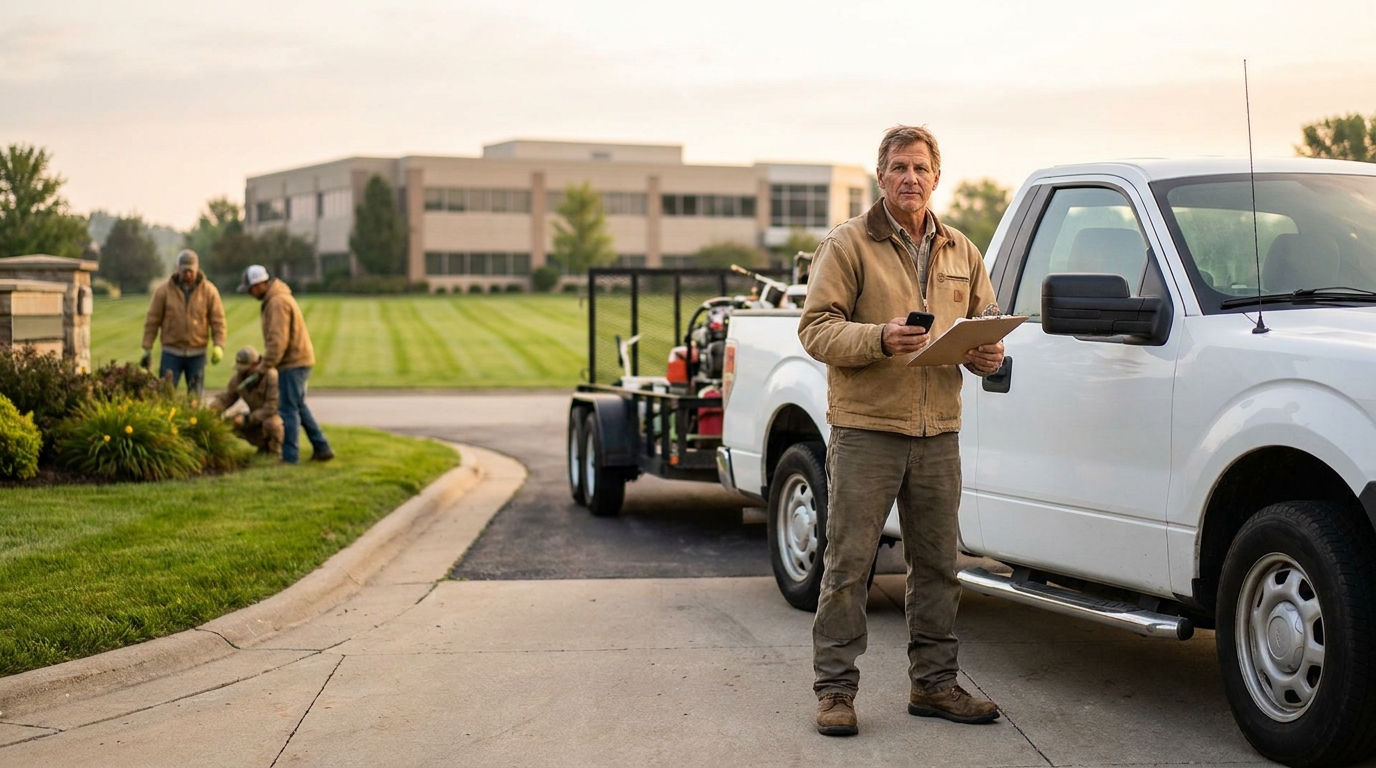
The subcontractor certificate you did not collect is a bill you get in January
Same audit, second mechanism, and this one is cheaper to prevent than any of it: "If you used subcontractors who cannot produce a valid certificate of insurance, the auditor can reclassify their labor as employee payroll."
Price it. Say you paid a sub $18,000 across a season - a common shape for the guy you call for the jobs you do not want. No certificate on file:
| How the sub's $18,000 gets rated | Added to your comp bill |
|---|---|
| Not reclassified (valid COI on file) | $0 |
| Reclassified at 0042 ground rate | $790 |
| Reclassified at 0106 tree rate | $1,373 |
The standard advice about collecting certificates from subs is always framed around liability: if they hurt someone, you do not want to be the deep pocket. That is true and it is also the less likely event. The near-certain event is the annual audit, and the invoice it produces. A tree sub is both the most likely sub to be uninsured and the most expensive one to have reclassified, which is a bad combination to discover in arrears.
Collecting a PDF before the first invoice gets paid is a five-minute habit worth up to $1,373 a season. We do not have a place to store it either - there is no certificate vault, no expiration tracking, no sub-compliance module in Landscapey. A labelled folder and a calendar reminder cost nothing and do the job.
Four carriers, one coverage limit, four prices
Here is where this category behaves exactly like the software category we usually write about. Insurance Canopy published a comparison on 2026-04-30 listing what several carriers charge a landscaping business for general liability at the same stated $2,000,000 base coverage limit:
| Carrier | Published monthly price | Installment fee | Annualised at that rate |
|---|---|---|---|
| Insurance Canopy | $40.00 ("$375 per year") | none published | $480 monthly / $375 annual |
| The Hartford | $62.83 ("$188.50/quarter") | $5/mo with AutoPay | $754 + $60 |
| NEXT (ERGO) | $100.84 | none published | $1,210 |
| Thimble | $161.40 | $2.50/mo | $1,937 + $30 |
That is a 4.0x spread on nominally identical limits, and roughly $1,487 a year between the cheapest and the dearest. Two honest observations about that table:
The comparison was published by one of the four companies in it, and the cheapest price is its own. We are not going to launder that. Insurance Canopy has an obvious interest in the ranking, the figures are specific enough to check, and you should check them - a real quote depends on your state, revenue, payroll, vehicles and claims history, none of which a comparison table knows about. The reason the table is worth showing at all is that the dispersion is the finding, not the winner.
The installment fees are the part that goes missing. The Hartford's $5 a month is $60 a year on a $754 policy - 8.0% on top, for the privilege of paying monthly. Thimble's $2.50 is $30 on $1,937, or 1.6%. Neither is enormous; both are outside the headline price, and paying annually usually removes them. Insurance Canopy's own numbers show the same thing from the other side: $40 a month is $480, but the annual price is $375 - $105, or 21.9%, for paying up front. If cash flow allows it, the single easiest saving in this entire article is paying the year in one go.
Read the limits, not the tier names
NEXT does something most of this search result does not: it publishes its actual coverage limits per plan rather than only a "get a quote" button. Credit where it is due, and the same for its certificates, which are "unlimited certificates of insurance (COI) to share proof of insurance at no extra cost," available 24/7 by web or app. That is genuinely useful and, as the next section argues, worth more than it sounds.
But read the ladder carefully, because it does not climb the way the names suggest. These limits were read directly from the page source on 2026-08-09:
| Coverage | Basic ("Lowest Price") | Pro ("Most Popular") | Pro Plus ("Best Coverage") |
|---|---|---|---|
| General liability, per occurrence | $300,000 | $100,000 | $1 million |
| Workers' comp, per accident | $100,000 | $500,000 | $1 million |
| Commercial auto, combined single limit | $85,000 | $100,000 | $1 million |
| Tools and equipment, per occurrence | $3,000 | $5,000 | $10,000 |
| Commercial property, per occurrence | $25,000 | $25,000 | $25,000 |
Moving from Basic to Pro raises your workers' comp limit fivefold and cuts your general liability limit by two thirds, from $300,000 to $100,000. The plan labelled "Most Popular" carries the weakest general liability limit of the three.
This is not hidden - it is printed in the table, which is more than most of this SERP offers. The finding is narrower and more useful than an accusation: tier names in insurance are not a coverage ranking. Pro is a different bundle, weighted toward employee injury rather than third-party damage. If your risk is a rock through a picture window or a customer's ankle in a hose loop, that is general liability, and the middle tier gives you less of it than the cheap one. Compare the numbers in the rows. Never the words at the top of the column.
The certificate is a revenue gate, not just a cost
There is a reading of this whole article in which insurance is $5,541 of pure overhead. For a purely residential book, that is more or less accurate, and the right move is to buy adequate limits as cheaply as you honestly can.
Commercial work inverts it. When we walked through how to win commercial and HOA contracts, the worked example was a $44,600-a-year HOA bid - and the certificate of insurance is the artifact that lets you into the packet at all. Property managers and HOA boards typically ask for limits in the $1 million per occurrence range, name themselves as additional insured, and will not read a bid without the paperwork. Under those terms the arithmetic changes shape:
- As overhead on a residential book: $5,541 against $99,840 is 5.6% of revenue you would rather not spend.
- As an entry fee for commercial bidding: the same $5,541 is 12.4% of a single $44,600 contract, one time, for access to a category of work with longer terms and better winter continuity.
The inversion that keeps this honest: that only pays if you actually win commercial work. Buying a $1M policy and never bidding a commercial job means you bought overhead and called it strategy. The sequence that works is to find the bids first, read what limits they demand, and then buy to that requirement.

What Landscapey does and does not do here
We are a CRM for landscapers, and it would be easy to end an article like this with a paragraph implying the software helps. Mostly it does not. The blunt version:
| What Landscapey does | What it does not do |
|---|---|
| Records the premium as a categorised expense so it lands in your financials and shows up against revenue | No certificate storage, no COI expiration tracking, no subcontractor compliance |
| Tracks revenue per client and per visit, which is what turns a premium into the per-visit numbers in this article | No time tracking against a job, so it cannot separate 0042 hours from 0106 hours |
| Keeps invoices and payments in one place, which is what an auditor asks for | No payroll, no comp reporting, no audit prep, no quote comparison |
The one claim we will make plainly, because it is checkable: payments run through Stripe Connect directly to your account with no platform fee on top. Everything else in the insurance conversation happens outside our product, and no software prevents an audit reclassification. Records do. If you want the expense side of the picture, the deductions guide covers how these premiums land at tax time, and the profit margin breakdown shows where a 5.6% overhead line sits in a real P&L. If you want the CRM, it is one plan at $19.99 a month.
Frequently asked questions
How much does lawn care business insurance cost per month?
At Insureon's published medians for landscaping customers: general liability $51, workers' comp $169, commercial auto $204, tools and equipment $38. A one-truck operation with one employee carrying all four runs about $461.75 a month, or $5,541 a year. A solo operator without employees, and therefore usually without workers' comp, runs about $292.67 a month. Roughly half of businesses pay more than these medians.
Do I need workers' comp if I am the only employee?
In most states an owner with no employees can exclude themselves, which is why the solo column in this article drops the $2,029. But workers' comp is regulated state by state, several states run their own funds, and the rules on owner exclusion, family members and part-time help vary. This is the single most state-specific item in the stack - confirm yours before assuming you can skip it.
What is a certificate of insurance and why does everyone keep asking for one?
It is a one-page proof that your policy exists, with limits and dates on it. Commercial clients, HOAs and property managers require one before they will consider a bid, and you should require one from every subcontractor you pay - because at your annual workers' comp audit, an uninsured sub's labour can be reclassified as your payroll and billed to you. On $18,000 of sub work that is $790 to $1,373. Some carriers, NEXT among them, issue unlimited certificates at no extra cost.
Why is my quote so much higher than the averages here?
Workers' comp is priced as payroll divided by 100, times your class code rate, times your experience modifier - so payroll size, what your crew actually does, and your claims history move it directly. Ground maintenance rates at a 2025 national average of $4.39 per $100 of payroll under code 0042; tree work at elevation rates $7.63 under 0106, about 74% higher. Commercial auto depends on vehicles, drivers and records. State matters throughout.
Is it cheaper to pay annually?
Usually yes, and by more than people expect. Insurance Canopy's own published figures are $40 a month or $375 a year - $105, or 21.9%, for paying up front. The Hartford adds a $5 monthly installment fee, which is $60 a year, or 8.0% on top of a $754 policy. Thimble adds $2.50 a month. If the cash is available in spring, paying the year removes the surcharge entirely.
Which coverage should I buy first if I cannot afford everything?
General liability, because it is the cheapest line in the stack and the one that answers the most common claim - property damage and third-party injury on someone else's lawn - and because it is the coverage the certificate everyone asks for is usually referring to. Then commercial auto if you drive to jobs, which you do. Workers' comp becomes non-optional the moment you hire, and in many states before that. This is a sequencing observation, not advice for your situation.
Sources and limits
- Median premiums: Insureon's landscaping insurance cost page, updated 2026-02-24, explicitly "sourced from the median cost of policies purchased by Insureon landscaping customers" - one broker's book of business, not an industry survey.
- Class codes and audit mechanics: TruPoint, published 2026-04-27. The 0042 and 0106 rates are stated as 2025 national averages; your state's filed rates will differ, sometimes considerably.
- Carrier price comparison: Insurance Canopy, published 2026-04-30 - a comparison published by one of the companies being compared, noted above.
- NEXT plan limits: read from nextinsurance.com's lawn care page source on 2026-08-09. Plan structures change; re-read before buying.
- The book behind every per-visit and per-client figure is one stated example - 60 clients, $52 a visit, a 32-week season, $99,840 - not a benchmark. Scale it to yours before using any of it.
- None of this is insurance advice, and nothing here is a quote. Prices published on a web page are a starting point; a broker who knows your payroll and your state is the only source of a number you can actually budget against, including this article.